


QES Medical Launches Cybersecurity Services for Compliance and Protection

Cybersecurity is now part of product safety, patient safety, operational continuity, and compliance readiness. For organizations that build connected medical devices, operate industrial systems, or manage sensitive enterprise data, security can no longer sit at the edge of the quality program.
QES Medical has expanded its services with the launch of a dedicated Cybersecurity Services team. The new division supports medical device manufacturers, industrial organizations, and enterprises that need practical security testing, clear risk guidance, and documentation that can stand up to regulatory and audit review.
The team brings together technical cybersecurity work and compliance experience, with services delivered through an ISO/IEC 27001-certified information security management environment. That means engagements are managed within a framework built around recognized information security controls, secure handling of client data, and disciplined project delivery.

Why QES Medical is expanding into cybersecurity
Cyber threats are growing across every connected environment. Medical devices exchange data with hospital networks. Software as a Medical Device, often called SaMD, can rely on cloud platforms and APIs. Manufacturing lines depend on operational technology and industrial control systems. Enterprise teams must protect networks, applications, endpoints, and regulated data while also preparing for audits.
At the same time, regulators and customers now expect stronger evidence of security. A basic checklist is not enough. Organizations need to show how they identify risks, test for vulnerabilities, monitor known issues, manage third-party components, and document controls.
That creates pressure across several teams:
Product teams need secure design and testing evidence.
Quality and regulatory teams need audit-ready documentation.
IT and security teams need a clear view of risk across systems.
Operations teams need protection for production environments.
Leadership needs a governance model that supports business decisions.
QES Medical’s cybersecurity division was created to help close those gaps. The goal is to provide cybersecurity services for compliance and protection in a way that fits regulated and complex environments, not just standard IT settings.
A security partner for regulated technology
Many organizations can run scans or write reports. Fewer can connect technical findings to compliance expectations, product safety, and audit evidence.
QES Medical’s Cybersecurity Services team focuses on three areas that often overlap:
Area | What it covers | Why it matters |
Medical device and SaMD security | Penetration testing, SBOM review, security risk assessment, and standards alignment | Supports safer connected products and stronger regulatory submissions |
OT and ICS security | Assessments for industrial control systems, manufacturing environments, and critical operations | Helps reduce downtime risk and protect systems that cannot be treated like standard IT |
Enterprise IT security | Network, cloud, application, API, and infrastructure security reviews | Gives organizations a clear view of technical risk across business systems |
This combined approach helps organizations avoid a common problem. Security work can become disconnected from the evidence needed for audits, regulatory submissions, and internal governance. QES Medical helps translate test results into meaningful risk decisions and usable documentation.
Compliance-driven audits and gap assessments
Security audits should do more than list missing controls. They should show where an organization stands, what needs attention, and how to prioritize next steps.
QES Medical provides compliance-driven audits and regulatory gap assessments aligned with recognized frameworks and standards, including:
ISO 27001
SOC 2
HIPAA
NIST Cybersecurity Framework
CIS Controls
Other applicable regulatory and security frameworks
These assessments help organizations understand whether current policies, processes, and controls match expected requirements. They can also help prepare for customer reviews, internal audits, certification efforts, and regulatory interactions.
A strong gap assessment can answer practical questions such as:
Are policies current, approved, and followed in practice?
Are access controls defined and reviewed?
Are security risks documented and assigned owners?
Are incident response procedures tested?
Are vendors and software components assessed?
Is evidence organized enough for an audit?
For regulated organizations, the answer matters. Strong controls are useful, but documented controls are what support review, accountability, and improvement.
Medical device cybersecurity testing
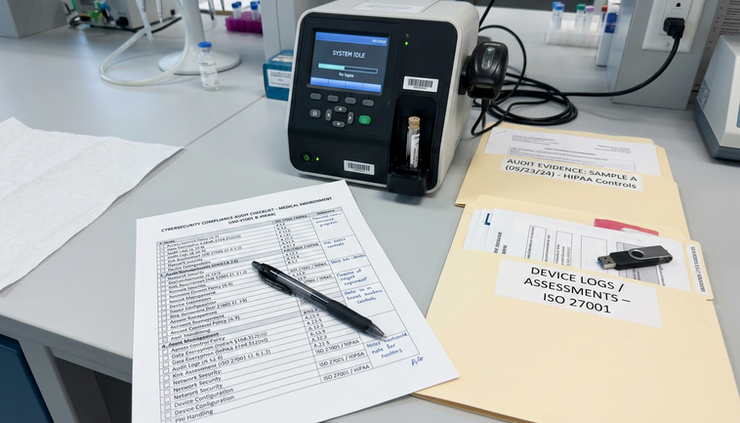
Connected medical devices face risks that are different from traditional software products. Security issues may affect data privacy, device availability, product performance, and patient safety. That is why cybersecurity testing must account for device architecture, intended use, clinical environment, and regulatory expectations.
QES Medical supports medical device manufacturers with services such as:
Penetration testing for connected medical devices
Security testing for SaMD
SBOM analysis
IEC 62443 assessments
IEC 81001-5-1 assessments
Cybersecurity documentation for regulatory submissions
Risk-based reporting and remediation support
Penetration testing can help identify weaknesses in device interfaces, APIs, authentication flows, encryption, update mechanisms, and connected services. SBOM analysis helps teams understand the software components inside a product, including open-source packages and known vulnerabilities.
This matters because manufacturers must be able to explain more than whether a vulnerability exists. They need to show how it affects risk, whether compensating controls exist, and how the issue will be tracked or resolved.
QES Medical also supports documentation for FDA 510(k) and EU MDR submissions, including cybersecurity evidence that can help demonstrate due care during product development and maintenance.
OT and ICS security for industrial environments
Operational technology environments need a careful security approach. Industrial systems often run continuously. Some equipment was designed before modern cybersecurity expectations existed. In many cases, downtime carries serious operational, safety, or financial consequences.
QES Medical provides OT and ICS security assessments for environments that support critical infrastructure, manufacturing operations, and industrial control systems.
These assessments may include review of:
Network segmentation
Remote access paths
Asset visibility
Industrial protocols
Patch exposure
Default or shared credentials
Backup and recovery readiness
Monitoring and alerting coverage
Connections between IT and OT networks
Unlike routine IT testing, OT security work must avoid unnecessary disruption. Testing plans need to account for production windows, safety requirements, equipment limits, and control system sensitivity.
A practical OT assessment gives teams a clearer map of their environment and the risks that need attention first. It can also help build a phased improvement plan, starting with items that reduce exposure without interrupting operations.
IT security assessments across infrastructure, cloud, and applications
Enterprise security depends on many connected layers. A weakness in one area can expose another. Cloud misconfigurations can affect sensitive data. API flaws can expose application functions. Flat networks can make incidents spread faster.
QES Medical’s IT Security Assessments cover infrastructure, networks, cloud platforms, and applications. These reviews are benchmarked against frameworks such as CIS, NIST, and ISO 27001.
Assessment areas can include:
Internal and external network security
Firewall and segmentation review
Cloud configuration review
Identity and access management
Web application security
API security
Endpoint and server hardening
Logging and monitoring
Backup and recovery controls
The result is a practical risk view, not just a technical list. Reports are written to support both technical remediation and management decisions. That helps security teams explain what needs to change, why it matters, and how serious each finding is.

Vulnerability assessment and penetration testing
Vulnerability Assessment and Penetration Testing, often called VAPT, helps organizations find and verify security weaknesses before attackers can use them.
QES Medical provides VAPT across:
Networks
Web applications
Mobile applications, where applicable
APIs
Cloud environments
Connected products
Supporting infrastructure
A vulnerability assessment identifies known weaknesses, misconfigurations, missing patches, and exposed services. Penetration testing goes further by safely testing whether a weakness can be exploited and what impact it may have.
Both are useful, but they answer different questions.
Service | Main question it answers | Typical output |
Vulnerability assessment | What known weaknesses exist? | Prioritized vulnerability list with severity and remediation guidance |
Penetration testing | Can an attacker use this weakness in practice? | Validated findings, attack paths, impact analysis, and remediation steps |
Combined VAPT | Where is the risk, and how serious is it? | Risk-based report suitable for technical teams and governance review |
For regulated organizations, VAPT reports can also support audit evidence, customer assurance, risk management files, and security improvement plans.
Risk and governance advisory
Cybersecurity is not only a technical function. It also depends on governance, ownership, policy, and repeatable decision-making.
QES Medical helps organizations build and improve cybersecurity governance programs aligned with ISO 27001, NIST CSF, and related frameworks. Services include cyber risk assessments, governance framework development, policy support, and practical control alignment.
A governance advisory engagement may address:
Security roles and responsibilities
Risk register structure
Policy and procedure review
Control ownership
Vendor and third-party risk
Incident response readiness
Management reporting
Security metrics
Program maturity planning
This work helps organizations turn cybersecurity from a set of separate tasks into a managed program. It also helps leadership see which risks need funding, ownership, or policy change.
Regulatory cybersecurity documentation
Regulatory cybersecurity documentation is often where technical work either becomes useful or gets lost.
QES Medical supports documentation for medical device submissions, compliance audits, and internal security programs. This includes cybersecurity documentation for FDA 510(k) submissions, EU MDR requirements, and audit-ready evidence packages.
This documentation may include:
Cybersecurity risk assessments
Threat modeling summaries
Security architecture descriptions
SBOM review evidence
Vulnerability management records
Penetration test summaries
Remediation plans
Residual risk justifications
Security maintenance plans
Good documentation makes the security story clear. It shows how risks were identified, tested, evaluated, and controlled. It also helps teams respond faster when regulators, auditors, customers, or internal stakeholders ask for evidence.
This content is informational only and does not replace legal or regulatory advice. Organizations should confirm applicable requirements for their specific products, markets, and use cases.
Continuous security support after the assessment
A single assessment can identify risk, but cybersecurity does not stop after the report is delivered. New vulnerabilities appear. Software components change. Threats shift. Regulations and customer expectations evolve.
QES Medical offers continuous security support to help organizations manage security over time. Services include:
Vulnerability management
CVE monitoring
Patch advisories
Remediation tracking
Incident response support
Security control review
Ongoing compliance evidence support
For product companies, this can support post-market activities and product maintenance. For industrial and enterprise clients, it can help teams track risk across changing systems and environments.
Continuous support is especially useful when organizations need help maintaining momentum after an assessment. Findings can be prioritized, owners can be assigned, and progress can be tracked in a way that supports both security improvement and compliance evidence.
Built on an ISO/IEC 27001-certified environment
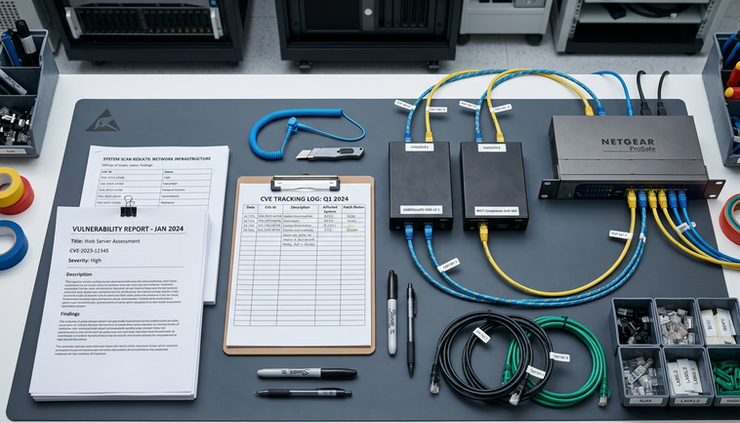
Client cybersecurity work often involves sensitive information, including network diagrams, device details, vulnerability findings, software inventories, and compliance records. Handling that information securely is part of the service itself.
QES Medical delivers cybersecurity services through an ISO/IEC 27001-certified information security management environment. This supports secure project handling and aligns delivery practices with internationally recognized information security controls.
For clients, this adds confidence that sensitive engagement data is managed within a structured security program. It also reflects the same discipline QES Medical helps clients build in their own environments.
What this launch means for clients
The launch of QES Medical’s dedicated Cybersecurity Services team gives organizations a partner that can connect security testing, risk governance, and compliance evidence.
Medical device companies can get support for connected product testing, SBOM analysis, cybersecurity documentation, and regulatory readiness. Industrial organizations can assess OT and ICS risks without treating production systems like ordinary IT assets. Enterprises can strengthen infrastructure, cloud, application, and governance programs against widely used security frameworks.
Cybersecurity has become a core part of quality, trust, and operational resilience. QES Medical’s expanded services are designed to help organizations protect systems, prepare for scrutiny, and make security decisions with clearer evidence.
The next step is simple: identify the systems, products, or compliance goals that carry the most risk, then assess them with a team that understands both cybersecurity and regulated environments.


Comments